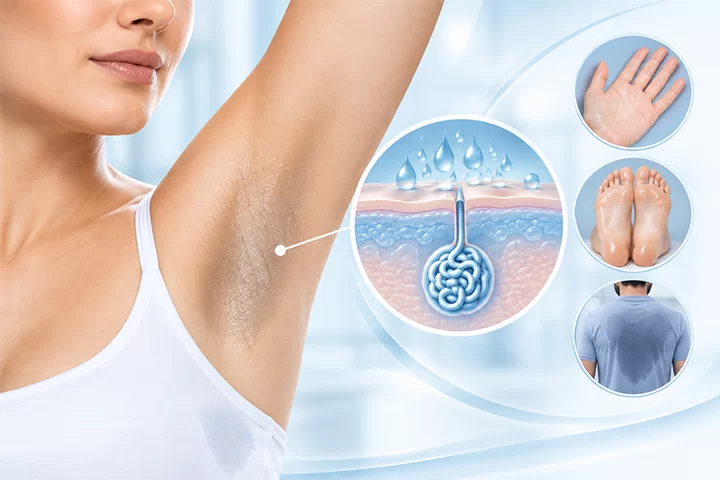
Hyperhidrosis is sweating far beyond what the body needs to control its temperature. It most often affects the palms, armpits, soles of the feet and face. It is more common than people think: a study in the USA found it in about 4.8% of the population. It can have a marked effect on social life, education and work, to the point where people avoid shaking hands, holding a pen or using a keyboard. Treatment options range from non-surgical methods to surgery.
Types of excessive sweating
- Primary focal hyperhidrosis: sweating affects particular areas (hands, feet, armpits, face) without any underlying disease. It is usually symmetrical, affecting both sides. It mostly starts in childhood or adolescence, usually stops during sleep, and often runs in families. It is caused by the sympathetic nervous system stimulating the sweat glands in these areas more than necessary.
- Secondary hyperhidrosis: this develops because of an underlying illness or a medicine. It usually affects the whole body, can start later in life and may continue during sleep. Possible causes include an overactive thyroid, diabetes, the menopause, infections, some medicines, obesity and, rarely, tumours. In this case, treatment is aimed at the underlying cause.
Surgery is considered only for primary focal hyperhidrosis. For this reason, secondary causes need to be ruled out before treatment.
Non-surgical treatment options
- Lotions and solutions that reduce sweating: products containing aluminium chloride are the first treatment to try for mild to moderate sweating.
- Iontophoresis: the hands and feet are placed in water and a mild electric current is applied. Regular sessions are needed.
- Botulinum toxin (Botox) injections: these work particularly well for underarm sweating. The effect is temporary, so the injections need to be repeated every few months.
- Medicines taken by mouth: anticholinergic medicines that reduce sweating can be used. Side effects such as a dry mouth, difficulty sleeping, poor concentration and difficulty passing urine may limit their use.
Surgical treatment: ETS surgery
Endoscopic thoracic sympathectomy (ETS) is an operation in which the sympathetic nerve chain that stimulates the sweat glands is cut or clipped at a particular level inside the chest. It is used for people with primary focal hyperhidrosis whose sweating has not responded well enough to non-surgical treatments and has a marked effect on their quality of life. It is most effective for the palms (99%).
- It is done under general anaesthetic, with a camera, through one small cut at armpit level on each side.
- Both sides are usually operated on in the same session, and the procedure does not take long.
- Most patients go home the same day or the next day, and return to their daily routine within a few days.
- The effect is noticeable straight away: the hands are already starting to dry when the patient leaves the operating theatre.
- The level at which the nerve chain is cut or clipped depends on where the sweating is.
Possible risks
- Excessive dryness of the hands
- Air left in the chest cavity (pneumothorax), which usually settles on its own
- Rarely, a drooping eyelid and a smaller pupil (Horner’s syndrome)
- Sweating partly coming back in the long term
Compensatory (reflex) sweating: the most important thing to know before surgery
This is the most common and most important complication after ETS. Sweating increases, mostly on the back, chest, abdomen and thighs. It is usually mild or moderate and generally appears in the first months after surgery. In some people it lessens over time. In a small number of patients, however, it can be severe enough to affect quality of life.
Recent studies, including our own, show that cutting the nerve chain at a single, lower level (especially at the level of the 4th rib) reduces the risk of compensatory sweating, while cutting it at more than one level and at higher levels increases the risk. This risk should be discussed with the patient in detail before any decision on surgery is made.
Treatment for reflex sweating
For patients who develop severe reflex sweating, we perform corrective operations that reconnect the nerve. In our experience, patients benefit considerably from this operation.
If you have questions about excessive sweating or ETS surgery, you can get in touch through the contact page. Prof. Dr. Celalettin Kocatürk sees patients at Medicana Ataşehir and Medicana Zincirlikuyu hospitals.