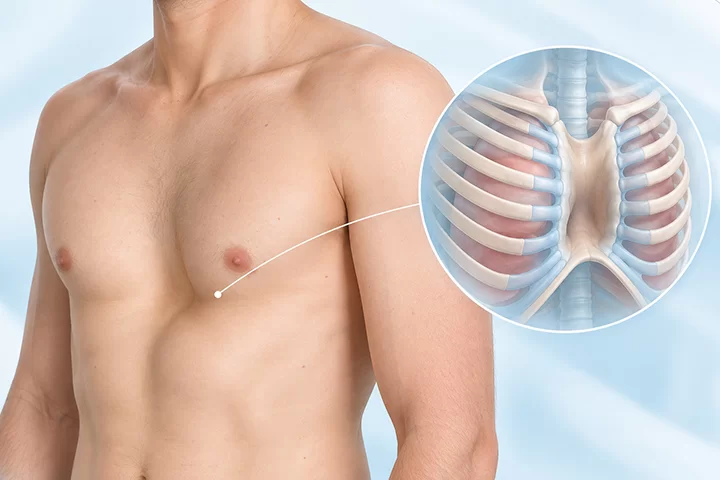
Pectus excavatum, a condition in which the front wall of the chest is sunken inwards, is the most common chest wall deformity. It is commonly known as sunken chest or funnel chest. It occurs in about 1 in 300 births and is more common in males. Severe cases can be noticed soon after birth. The deformity becomes more noticeable with age and with the rapid growth of puberty. Not everyone needs treatment. The decision depends on how severe the deformity is and on the physical, psychological and social effects it has on the person.
What causes it?
The cartilages that join the ribs to the breastbone (sternum) grow too much and unevenly, and push the breastbone inwards. The exact cause is not known. Many patients have a family member with a similar deformity. The condition most often seen alongside it is scoliosis (curvature of the spine). It can also occur with Marfan syndrome and some other connective tissue disorders, so heart and genetic assessments are carried out when needed. The deformity is often asymmetrical: the right or left side may be more sunken.
Symptoms and effects
- Effects on appearance: this is the most common reason people seek help. Young people may lose self-confidence, avoid settings such as swimming and sport, and develop a hunched posture.
- Physical symptoms: with a marked deformity, there may be breathlessness on exertion, tiring quickly, chest pain and palpitations.
- Effects on the heart and lungs: in severe cases, pressure on the heart can lead to heart valve problems and a reduced ability to exercise.
Assessment
The diagnosis is made mainly by physical examination. Where needed, front and side chest X-rays are taken, and sometimes a CT scan of the chest. The depth of the deformity and its effect on the heart are assessed. The Haller index gives the severity of the deformity as a number. It is calculated by dividing the width of the chest by the distance between the breastbone and the spine. A value above 3.25 usually indicates a marked deformity, but the decision on treatment is not based on this value alone. When needed, an echocardiogram (heart ultrasound), an electrocardiogram (ECG), lung function tests and an exercise test are carried out.
Treatment options
Vacuum bell (non-surgical treatment)
A special vacuum device placed on the front of the chest draws the breastbone outwards. It is most effective for mild to moderate deformities, and in childhood and early adolescence, while the chest is still flexible. The device has to be used regularly over a long period. The result depends on how long it is used and how closely the patient sticks to the routine. The chance of success is very high in people whose chest is flexible.
Nuss procedure (minimally invasive repair)
This is now the most commonly used operation to correct pectus excavatum. Through small cuts on both sides of the chest, and guided by a camera (thoracoscopy), a metal bar shaped specifically for the patient is placed behind the breastbone. The bar pushes the breastbone outwards from the inside and corrects the deformity. More than one bar is used when needed. For patients with a nickel allergy, a titanium bar is preferred, so patients are asked about allergies before the operation.
The bar is usually left in place for 2–3 years so that the chest can permanently take on its new shape. It is then removed in a procedure done as a day case or with a short hospital stay.
Open repair (Ravitch procedure)
This is the classic method. Through an incision in the front of the chest, the cartilages causing the deformity are removed and the breastbone is reshaped.
The right age for surgery
The best time for the Nuss procedure is adolescence, while the chest is still flexible. This is generally considered to be 10–16 years of age. When the operation is done at a younger age, the risk of the deformity coming back during growth is higher. It can also be done in adults. However, because the chest is stiffer, the operation is more difficult, recovery takes longer, more than one bar may be needed and there is a little more pain after the operation.
Recovery after surgery
There may be pain in the first few days after the Nuss procedure. Patients usually go home within a few days. Most can return to school or a desk job within 2–3 weeks. In the first weeks, to stop the bar moving out of place, patients should keep an upright posture and avoid lying on their side, heavy lifting and bending the body too far. Returning to contact sports is usually possible after the first 3 months, with the doctor’s approval.
If you have questions about treatment for pectus excavatum and other chest wall deformities, you can get in touch through the contact page. Prof. Dr. Celalettin Kocatürk sees patients at Medicana Ataşehir and Medicana Zincirlikuyu hospitals.