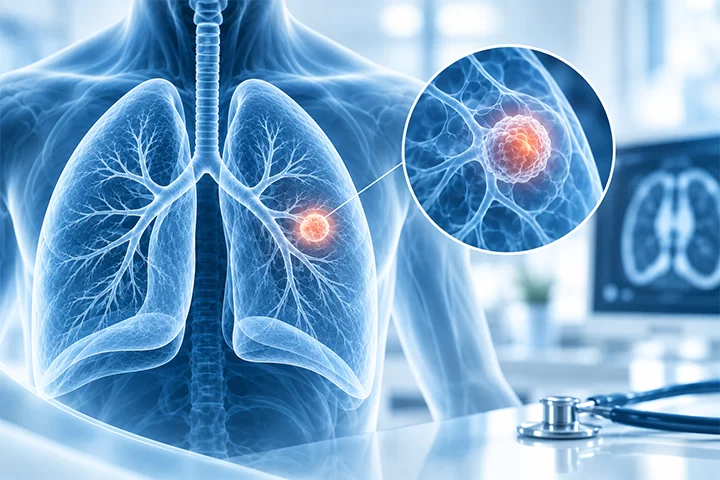
A lung nodule is a round or oval area of tissue, smaller than 3 cm, that shows up on a chest X-ray or CT scan. It is also commonly called a “spot on the lung”. Now that CT scans are widely used, nodules are found very often, and the great majority are benign. Whether a nodule is cancer is decided by looking at several things together: its size, its shape, its structure, how it changes over time and the person’s risk factors.
Why do lung nodules form?
Most nodules are scar tissue left behind by past infections or inflammation. The main causes are:
- Benign causes: granulomatous nodules, such as those left by past tuberculosis or fungal infections, scars left after pneumonia, lymph nodes within the lung, benign tumours such as hamartoma, nodules linked to conditions such as rheumatoid arthritis and sarcoidosis, complicated benign cysts, and a tangle of blood vessels (arteriovenous malformation)
- Malignant causes: cancers of the lung, and cancer that has spread to the lung from another organ (metastasis)
Does a lung nodule cause symptoms?
Lung nodules usually cause no symptoms at all. They are generally found by chance on scans taken for another reason. Symptoms such as a cough, blood-stained phlegm or shortness of breath may point to another underlying condition rather than to the nodule itself, and they should be assessed separately.
How is a nodule’s likelihood of being benign or malignant assessed?
- Size: Small nodules carry a very low chance of cancer. The chance rises as the size increases.
- Structure: On CT, a nodule may look solid (completely dense), ground-glass (semi-transparent) or a mixture of both (part-solid). Part-solid nodules need closer assessment.
- Edges and shape: Nodules with smooth edges and calcification are usually benign. Nodules with irregular or spiky (spiculated) edges are examined more carefully.
- Change over time: If a solid nodule keeps the same shape and size over several years, this suggests it is benign. Ground-glass nodules can grow very slowly, so they are followed up for longer.
- Personal risk: Age, smoking history, a family history of lung cancer, exposures at work and any previous cancer are taken into account.
How are nodules followed up?
For nodules found by chance, the most widely used follow-up guidance in the world is the set of recommendations published by the Fleischner Society. Under these guidelines, the general approach to solid nodules in adults is as follows:
| Nodule size (solid) | Person at low risk | Person at high risk |
|---|---|---|
| Smaller than 6 mm | No routine follow-up needed | Optional CT scan at 12 months |
| 6–8 mm | CT scan at 6–12 months, repeated at 18–24 months if needed | CT scan at 6–12 months and again at 18–24 months |
| Larger than 8 mm | Assessed with a CT scan at 3 months, PET-CT or biopsy | Assessed with a CT scan at 3 months, PET-CT or biopsy |
Ground-glass and part-solid nodules are followed up for longer, usually for up to five years. This table is a general framework. The doctor decides the follow-up plan based on the features of the nodule and the person’s circumstances. Nodules found during lung cancer screening are assessed with a different system (Lung-RADS).
When are further tests needed?
Further tests are carried out if a nodule grows during follow-up, if a solid part develops within a ground-glass area, or if the first assessment finds a high chance of cancer:
- PET-CT: Usually used for solid nodules larger than 8 mm, to assess their metabolic activity.
- CT-guided needle biopsy: Provides a tissue diagnosis for nodules close to the outer parts of the lung.
- Bronchoscopy and EBUS: Used for centrally placed nodules close to the main airway, and to assess the lymph nodes.
- Surgical biopsy: Used for nodules with a high suspicion of cancer that cannot be diagnosed by another method. The nodule is removed by VATS or RATS and sent for pathology examination during the operation (frozen section). If cancer is found, a resection to treat it can be carried out in the same operation where appropriate.
Treatment of lung nodules
Nodules thought to be benign need no treatment. Follow-up at the recommended intervals is enough. For nodules diagnosed as cancer, or found to have a high chance of being cancer, treatment is planned according to the stage of the disease. For lung cancer found at an early stage, surgery is the gold standard: it offers the chance of a lasting cure and can often be done with keyhole methods.
If you have questions about the assessment and follow-up of lung nodules, you can get in touch through the contact page. Prof. Dr. Celalettin Kocatürk sees patients at Medicana Ataşehir and Medicana Zincirlikuyu hospitals.