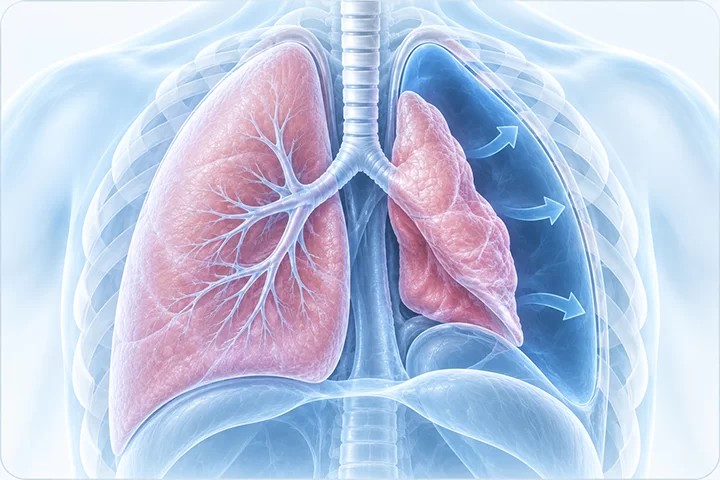
A pneumothorax happens when air leaks out of the lung and fills the space between the lung and the chest wall. This air presses on the lung and makes it collapse, partly or completely. It usually starts with sudden chest pain and shortness of breath. Treatment depends on the type of pneumothorax, its size, how severe the symptoms are and whether it has happened before.
Types of pneumothorax
- Primary spontaneous pneumothorax: Develops in people with no known lung disease. It is most common in tall, thin young men and in people who smoke. It is usually caused by small air-filled sacs (blebs and bullae) bursting at the top of the lung.
- Secondary spontaneous pneumothorax: Develops because of an underlying condition such as COPD, emphysema, cystic fibrosis, lung infections, lung cancer, sarcoma that has spread to the lung (metastases) or some rare lung diseases. A pneumothorax in people with COPD in particular can be serious, because their lung reserve is already reduced.
- Traumatic pneumothorax: Develops as a result of broken ribs, road traffic accidents, falls, stab wounds and other injuries from sharp objects, or gunshot wounds.
- Iatrogenic pneumothorax: Can develop after medical procedures such as a lung biopsy, insertion of a central venous line or mechanical ventilation (being on a breathing machine).
- Catamenial pneumothorax: A rare type of pneumothorax in women that keeps coming back around the time of their periods. It is usually linked to endometriosis affecting the diaphragm.
Symptoms
- Sudden, sharp, stabbing chest pain
- Shortness of breath
- Rapid breathing and palpitations
- Dry cough
Breathlessness that gets worse quickly, low blood pressure, turning blue or confusion can be signs of a tension pneumothorax, in which the pressure inside the chest rises to a dangerous level. This needs emergency treatment.
Diagnosis
A pneumothorax is usually diagnosed with a chest X-ray. A CT scan (computed tomography) is more sensitive at showing a small pneumothorax and at finding bullae, which raise the risk of it coming back. In the emergency department (A&E), an ultrasound scan can also help with the diagnosis. Oxygen levels are monitored with a pulse oximeter.
Treatment options
| Option | Who it may be suitable for |
|---|---|
| Observation (conservative treatment) | Patients with primary spontaneous pneumothorax who are stable and have no significant pain or shortness of breath. The air is absorbed on its own over time. |
| Needle aspiration | Patients who are not suitable for observation. The air is drawn out through a thin needle. |
| Ambulatory treatment devices | In suitable centres, treatment without a hospital stay, using small drainage devices with a one-way valve |
| Chest drain | Large, symptomatic or secondary pneumothorax, and cases where aspiration has not been enough |
| Surgery (VATS) | Recurrent pneumothorax, a prolonged air leak or a high risk of recurrence |
When is surgery needed?
In line with current recommendations, surgery is usually considered in the following situations:
- A second pneumothorax on the same side
- A first pneumothorax in the opposite lung
- A pneumothorax in both lungs at the same time
- An air leak that continues, or a lung that does not re-expand, despite several days of chest drain treatment
- A tension pneumothorax at the first episode
- Large bullae in both lungs
- Occupations in which a recurrence would be a serious risk, such as pilots, divers, military personnel and long-distance drivers. For these people, surgery is considered even after a first episode.
The operation is usually done by VATS, that is, as keyhole surgery. The bullae causing the air leak are removed. A procedure is then carried out that makes the lung stick to the chest wall, which prevents recurrence (surgical pleurodesis or pleurectomy). Most patients go home within a few days.
Risk of recurrence and what to look out for
In a significant proportion of people who have had a primary spontaneous pneumothorax, it can come back on the same side, especially in the first few years. Smoking markedly increases the risk of recurrence. After treatment:
- Stop smoking and using any tobacco products completely.
- Avoid flying until your lung has fully healed and your doctor has given approval.
- If you have had a pneumothorax, scuba diving can only be considered after surgical treatment and an assessment by a specialist.
- Decide with your doctor when to return to strenuous exercise and contact sports.
- Avoid mountaineering and high altitudes in the first few weeks.
- If sudden chest pain or shortness of breath comes back, go to A&E without delay.
If you have questions about the treatment of pneumothorax and preventing it from coming back, you can get in touch through the contact page. Prof. Dr. Celalettin Kocatürk sees patients at Medicana Ataşehir and Medicana Zincirlikuyu hospitals.