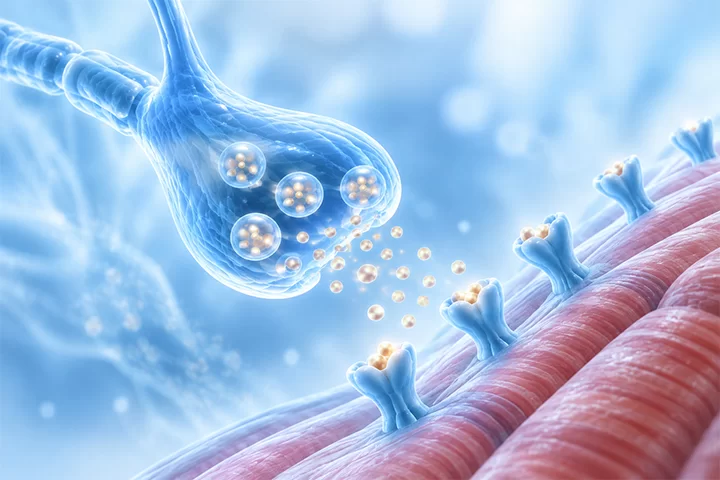
Myasthenia gravis is a long-term (chronic) autoimmune disease in which antibodies made by the immune system block the signals sent from nerves to muscles. Its main feature is muscle weakness that gets worse the more the muscles are used and improves with rest. Diagnosis and drug treatment are managed by a neurologist. Because the thymus gland plays an important part in how the disease develops, removing the thymus gland (thymectomy) is part of treatment for suitable patients.
How does myasthenia develop?
In a healthy person, acetylcholine is released from the nerve endings. It attaches to receptors on the surface of the muscle and makes the muscle contract. In myasthenia, the immune system makes antibodies against these receptors. Most patients have antibodies against the acetylcholine receptor (AChR). A smaller number have antibodies against structures called MuSK or LRP4. The thymus gland is closely involved in producing these antibodies. About 10–15% of people with myasthenia have a tumour of the thymus gland (thymoma).
Symptoms
Symptoms vary during the day. They are usually milder in the morning and get worse towards the evening or with tiredness.
- Drooping eyelid (ptosis) and double vision: in most patients, these are the first symptoms.
- Difficulty chewing, swallowing and speaking, and a nasal-sounding voice
- Weakness of the facial muscles and changes in facial expression
- Weakness in the arms, legs and neck that gets worse with use
- In more advanced cases, breathlessness can develop because the breathing muscles are affected, and difficulty swallowing because the chewing and swallowing muscles are affected.
If the disease affects only the eye muscles, it is called ocular myasthenia. If it also affects other muscles of the body, it is called generalised myasthenia.
Myasthenic crisis
A myasthenic crisis is an emergency in which the breathing and swallowing muscles become severely weak, and breathing support may be needed. Infections, some medicines, operations and interruptions to treatment can trigger a crisis. If breathlessness or difficulty swallowing gets markedly worse, go to an emergency department (A&E) straight away.
Diagnosis
- Antibody tests: a blood test for AChR antibodies. If this is negative, MuSK and LRP4 antibodies are tested.
- Electrophysiological tests: repetitive nerve stimulation and single-fibre EMG show problems with signal transmission between nerve and muscle.
- Chest CT scan: done for everyone diagnosed with myasthenia, to assess the thymus gland and look for a thymoma.
Treatment
Treatment for myasthenia is tailored to each person. It is planned jointly by neurology and thoracic surgery, according to how severe the disease is, the type of antibody, the person’s age and any other conditions they have.
- Medicines that ease symptoms: drugs such as pyridostigmine make signal transmission between nerve and muscle easier and so increase muscle strength.
- Medicines that regulate the immune system: steroids (corticosteroids) and drugs such as azathioprine and mycophenolate are used for long-term control of the disease.
- Fast-acting treatments: plasma exchange (plasmapheresis) and intravenous immunoglobulin (IVIG). These are used during a crisis and to prepare for surgery.
- Newer targeted treatments: in recent years, FcRn inhibitors (efgartigimod, rozanolixizumab), which help the body clear antibodies more quickly, and drugs that block the complement system (eculizumab, ravulizumab, zilucoplan) have been approved. These drugs offer new options, especially for patients who do not respond to standard treatment. A neurologist decides whether to use them.
- Thymectomy: surgical removal of the thymus gland in suitable patients.
The role of thymectomy
International randomised trials have studied patients aged 18–65 with generalised myasthenia who are AChR antibody positive and do not have a thymoma. They showed that in these patients, adding thymectomy to medication eases symptoms, reduces the need for steroids and markedly reduces hospital admissions. Every patient with myasthenia who has a thymoma needs surgery because of the tumour.
Today, thymectomy can be done in most patients by keyhole methods such as VATS or robotic surgery. The effect of the operation appears gradually, and a clear improvement is usually seen within months. Getting the disease under control with medication before the operation is important for safe surgery.
Living with myasthenia
- Some antibiotics, heart medicines and muscle relaxants can make the symptoms of myasthenia worse. Before starting any new medicine, it is very important to tell your doctor that you have myasthenia.
- Infections can make symptoms worse, so it is advisable to keep your vaccinations up to date, as your doctor recommends.
- Planning your day with rest breaks between activities reduces tiredness.
- Women who are planning a pregnancy should plan it together with their neurologist.
If you have questions about myasthenia gravis and thymectomy, you can get in touch through the contact page. Prof. Dr. Celalettin Kocatürk sees patients at Medicana Ataşehir and Medicana Zincirlikuyu hospitals.