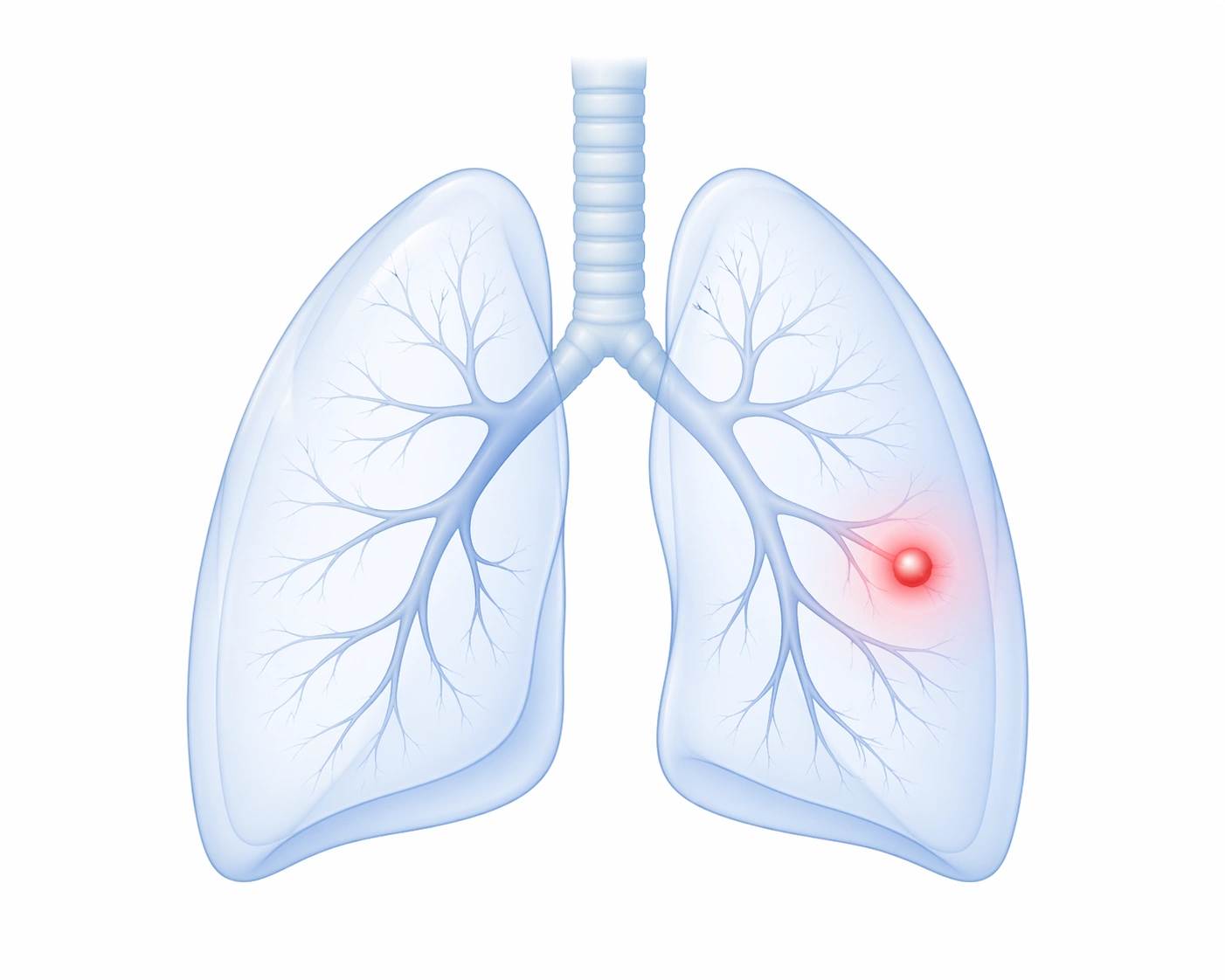
A lung nodule is a small lesion found within the lung tissue, denser than the lung around it and usually round or oval in shape. Most of the time it is noticed by chance on a chest X-ray or CT scan taken for another reason. This finding is very common in clinical practice and does not, on its own, mean cancer. Reliable patient information sources also state clearly that a large proportion of the nodules found in the lung are linked to benign causes and can appear after old infections, scar (repair) tissue or inflammatory processes.
One of the questions patients ask most often is: “A nodule has been found in my lung; could it be cancer?” Most of the time it is not right to answer this in a single sentence, because not every nodule means the same thing. The size of the nodule, its shape, its margins, its internal structure, whether there is one or several, how it changes over time and the patient’s clinical features have to be assessed together. The Fleischner Society, an international, multidisciplinary society for thoracic radiology, publishes guidelines on the diagnosis and management of lung nodules. These guidelines, which are used throughout the world, stress that the type and size of the nodule and the patient’s risk factors must be considered together before a nodule can be interpreted.
Why do lung nodules form?
Lung nodules can arise for different reasons. Remnants of past infections, changes following tuberculosis, fungal infections, cysts, inflammatory diseases, rheumatic diseases, certain benign tissue changes, a lymph node within the lung and, more rarely, early-stage lung cancer can all appear as a nodule. For this reason, when a nodule is found the first step is not to let anxiety grow but to analyse correctly what kind of finding it is. Many patient information sources also note that a large proportion of nodules may be due to infection, scarring or inflammation.
Is every nodule cancer?
No. Not every nodule seen in the lung is cancer. On the contrary, a large proportion of the nodules detected on imaging are benign. The American Cancer Society states that most lung nodules seen on CT scans are not cancer and are often related to old infection, scar tissue or other benign causes. NHS sources in the UK similarly state that the great majority of lung nodules are benign and that only some may be linked to early-stage lung cancer.
What matters here is less the presence of a nodule than being able to tell which nodule needs to be assessed more carefully. Older age, a history of smoking, lung cancer in the family, a large nodule, an irregular or spiculated margin (with spiky projections outwards) and a tendency to grow over time are among the features that increase the likelihood of malignancy (a malignant tumour; cancer).
What questions should be asked when a nodule is found?
When a nodule is seen in the lung, the assessment should be systematic. The following questions are particularly important:
- How many millimetres is the nodule?
- Is there one, or more than one?
- What is its density?
- Is it solid?
- Is it subsolid (part-solid)?
- Does it have a ground-glass appearance (ground-glass opacity, GGO: a hazy area on the scan where the lung tissue is denser than normal)?
- Is the nodule present on earlier imaging?
- Has the size or structure of the nodule changed over time?
- Does the patient have a history of smoking?
- Has there been a previous infection, pneumonia, tuberculosis or other lung disease?
- Is there lung cancer in the family?
- Has there been occupational or environmental exposure (asbestos, toxic gases, chemicals and so on)?
The answers to these questions determine whether simple follow-up or further investigation is needed. The main purpose of the guidelines is to avoid unnecessary procedures while directing higher-risk cases to further assessment without delay.
Why does the size of the nodule matter?
Size is one of the basic measures in assessing a nodule. In general, the larger the nodule and the further it is above certain thresholds, the greater the likelihood of malignancy. Very small nodules are therefore not assessed in the same way as larger ones. The Fleischner Society recommendations set out the need for follow-up, and its timing, separately according to the diameter and structure of the nodule and the patient’s level of risk.
That said, deciding on size alone is not enough. A small nodule is not necessarily insignificant, and a larger nodule may be benign. The essential thing is that the imaging findings are interpreted together with the clinical information.
How is a nodule followed up?
A large proportion of lung nodules do not need surgery. In many patients the right approach is follow-up with CT scans of the chest at set intervals. The aim is to see whether the nodule stays the same, shrinks or grows. The basic purpose of follow-up imaging is to observe how the nodule behaves over time.
The type of nodule also affects the follow-up plan. Subsolid or ground-glass nodules in particular may need different, and sometimes longer, follow-up than solid nodules. For this reason there is no single standard schedule for every patient; the follow-up plan should be set individually.
When is further investigation needed?
Some nodules are not simply followed up; they need further assessment. Additional investigation is considered in particular when:
- the nodule is large
- it has an irregular margin
- it grows over time
- the patient is in a high-risk group
- the imaging features point towards malignancy
In these situations a PET-CT scan, more detailed chest imaging, bronchoscopy, biopsy or surgical assessment may be planned. The American Cancer Society notes that, when a lung nodule is found, some patients may need additional tests to be sure that it is not cancer.
Do lung nodules cause symptoms?
Most lung nodules cause no symptoms at all. They are generally found by chance on imaging carried out for other reasons. If the nodule is small, it would not be expected to cause complaints such as a cough, pain or breathlessness. Where there are symptoms, the cause is not always the nodule itself; another underlying lung condition may be present as well. NHS patient information also states that nodules mostly do not make people feel unwell and are without symptoms.
How should a lung nodule be approached?
Finding a nodule in the lung can naturally cause anxiety. But it is important to know that this finding does not, on its own, mean cancer. A large proportion of lung nodules arise from benign causes. What really matters is less the presence of the nodule than a correct analysis of what kind of nodule it is, which risk factors it is being assessed alongside and how it behaves over time.
For this reason, when a nodule is found the approach should be based not on fear but on clinical assessment. A sound interpretation is not possible without considering the size and structure of the nodule, its imaging features, the patient’s age and smoking history and any other findings together. In some patients regular follow-up alone is enough, while in others further investigation may be needed. What decides this is an individual, evidence-based assessment.
Do not be anxious; but do not ignore your nodule either. Correct assessment of lung nodules is particularly important for patients in a high-risk group.
You can follow us on Facebook, Instagram and YouTube.
This article is for general information only and does not replace an individual medical assessment.