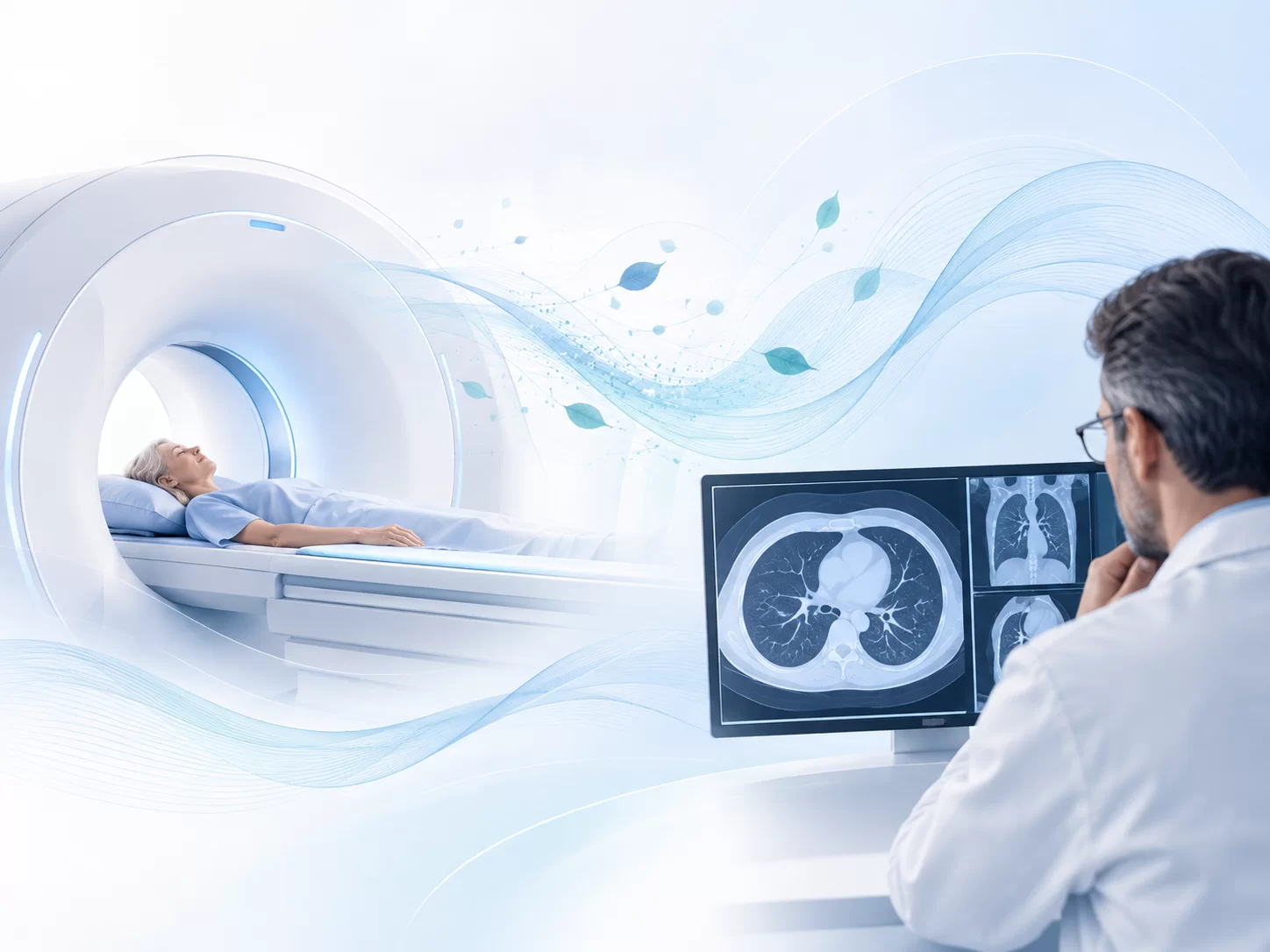
Lung cancer generally causes no obvious complaint in its early stages. For this reason, one of the questions patients ask most often is: “I have no symptoms at all, but should I have a CT scan of my lungs?”
The answer is not the same for everyone. A low-dose CT scan of the lungs is not a general check-up for everyone without symptoms. It is a screening method used in particular people who are at high risk of developing lung cancer, so that the disease can be detected before it causes symptoms. The basic principle is this: screening is meaningful when it is done in the right person at the right time.
What is a low-dose CT scan?
Low-dose computed tomography (LDCT) is a method that images the lungs in detail using a lower dose of radiation than a standard CT scan of the chest.
With this examination, small nodules in the lung tissue and early-stage tumours that have not yet caused symptoms can be detected. The aim in lung cancer screening is not to assess the patient after complaints have begun, but to find the disease at as early a stage as possible in people at high risk. A low-dose CT scan is generally performed without contrast and takes only a short time.
Who is low-dose CT screening recommended for?
The group that benefits most from lung cancer screening is people at high risk, particularly because of smoking. It is recommended for people who:
- are over 50 years of age, and
- have a smoking history of 20 pack-years or more.
Pack-years express a person’s total smoking exposure. For example, smoking one pack a day for 20 years is 20 pack-years; smoking two packs a day for 10 years is also 20 pack-years.
Should everyone be screened for lung cancer?
No. The benefit of low-dose CT has been shown in people whose risk of lung cancer is sufficiently high. Repeating CT scans in a low-risk person simply “as a check” can lead to unnecessary investigations rather than benefit.
When a finding that is not cancer is judged suspicious during screening, this is called a “false positive result”. In that situation, further investigations such as additional CT scans, PET-CT, bronchoscopy or biopsy may be raised unnecessarily. The aim of screening is therefore not to scan as many people as possible, but to identify the right people in whom the risk of dying from lung cancer can be reduced.
Is a low-dose CT scan “screening” in someone who has symptoms?
An important distinction needs to be made here. Lung cancer screening is essentially for high-risk people who do not yet have any symptoms or signs. Assessing someone who has a cough that persists or changes in character, blood in the phlegm, unexplained weight loss, steadily worsening breathlessness, chest pain or other suspicious complaints is no longer “screening”.
In that case the doctor’s aim is to investigate the illness causing the symptom, and the imaging needed is chosen according to the patient’s clinical condition. So the approach “I have symptoms, I’ll have a screening scan” is not right. A person with symptoms should have a diagnostic assessment.
Why does low-dose CT matter for early diagnosis?
In lung cancer, the stage at which the disease is found has a major effect on the treatment options available. When the disease is found while it is confined to the lung, there is a higher likelihood that curative treatment, above all surgery, can be offered; that is, treatment that aims to remove the disease completely.
Many studies have shown that low-dose CT screening can reduce the rate of death from lung cancer.
What happens if a nodule is found on a screening scan?
Finding a nodule on a low-dose CT scan does not mean that the patient has lung cancer. Lung nodules can also develop as a result of:
- previous infections
- scar (repair) tissue
- inflammatory processes
- certain benign conditions
For this reason, a nodule seen on screening is not assessed simply as “present or absent”. Its size, structure, density, number, margins and position, and whether it has grown compared with any earlier images, are considered together.
The results can be summarised as a nodule at “low”, “intermediate” or “high” risk of being cancer.
For many low- and intermediate-risk nodules, the first step is not a biopsy or an operation. Repeating the CT scan after a set interval and watching how the nodule behaves over time may be enough. Where a high-risk nodule is found, the process of diagnosis and treatment should be started.
The aim is to recognise a risky lesion without delay while not exposing the patient to unnecessary procedures and surgery because of findings that are very likely to be benign.
How often is screening done?
In the appropriate risk group, low-dose CT of the lungs is generally carried out once a year. However, whether screening continues is not decided by age alone. Previous imaging results, the person’s smoking history, their general health and whether treatment could be given if lung cancer were found are also taken into account.
The benefit of screening is reduced in someone whose life expectancy is markedly limited by serious health problems, or who could not be treated even if lung cancer were found.
Does low-dose CT carry any risks?
The term “low-dose” does not mean there is no radiation. The radiation used is much less than in a standard CT scan, but with repeated examinations the total exposure also has to be considered.
In addition, one of the important limitations of screening is false positive results. In some cases there may also be overdiagnosis, which means detecting a cancer that would never have caused a clinical problem during the person’s lifetime. The benefits and possible harms of screening therefore need to be weighed together. This is one of the main reasons screening programmes are restricted to people at high risk.
What I particularly remind my patients
Having no symptoms at all does not mean there is no risk of lung cancer, especially if you have a long and heavy smoking history.
Equally, having CT scans at frequent intervals purely out of worry, without a risk assessment, is not right either.
The right approach is to consider age, smoking exposure, the time since stopping smoking and general health together, and to decide whether the person would truly benefit from screening. The aim of screening is not to take more CT scans; it is to find the disease at a treatable stage in people who are at risk of lung cancer.
This article is for general information only and does not replace an individual medical assessment.